

The client work
IBM's Client Engineering team works directly with enterprise companies — figuring out what they actually need before anyone touches a solution. I was embedded in the PubFed squad, a cross-functional team of designers, engineers, data scientists, and business strategists, working under Innovation Designer Mark Ainscow.
My main project was leading Mural workshop sessions with two healthcare organizations.
-
CVS Health
CVS Health — one of the largest healthcare companies in the US, with 300K+ employees and pharmacy and insurance operations reaching millions of Americans — was sitting on aging on-premise infrastructure and needed to figure out if they were ready to move to the cloud. I led a structured readiness assessment — mapping their existing architecture, software compatibility, custom applications, data services, and disaster recovery setup — to get a clear picture of where they actually stood before anyone talked about migration.
The assessment revealed what needed to happen first. From there, we co-created a migration plan together: moving their FileNet Content Manager to a cloud environment, deploying containers, installing the operator, and completing post-deployment tasks. It gave them a concrete, sequenced path forward instead of an overwhelming leap into the unknown.
-
MCNA
MCNA, part of UnitedHealth Group, had a different problem. They were confident in their solutions but hadn't done the discovery work to back them up. I ran a discovery session built around one question: what are the issues you're actually facing?
We worked through empathy mapping — asking who the users were, what problems they were really solving, what success looked like, and what was getting in the way. What emerged was a clearer picture of where their data management was breaking down, and a direction toward IBM Watson Orchestrate as a solution to help them manage workflows and automate processes they were still doing manually.
The console redesign
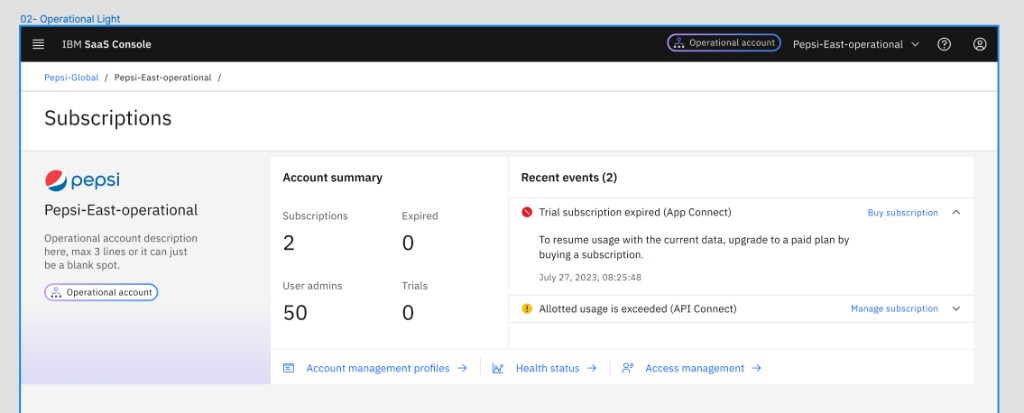
Toward the end of my internship I joined Lead UX Designer Brian Calder and Design Manager Rami Alayan on a separate project — redesigning the IBM SaaS Console notification system.
Enterprise clients couldn't tell when their trial or subscription had ended or run into an issue. The alerts existed but weren't landing. I redesigned the notification dashboard so subscription and trial statuses were clear and impossible to miss — and wrote all the notification content myself, making sure the language was specific enough that anyone could act on it immediately.
The redesign was approved by stakeholders and handed off for development.
Building something for the next generation
Building community has always been something I care about — and IBM was no different. Alongside everything else, I collaborated with other designer interns to build a resource guide for future IBM designers — something we wished had existed when we started.
We designed a learning framework that included mock client workshops so interns could practice facilitation before ever getting in front of a real client, a roadmap for navigating the Client Engineering environment, practice sessions, and a curated list of articles, videos, and tools we actually used.
It was a small thing. But it came from the same instinct that led me to found a student organization at UC Davis, help grow WiCS, and keep showing up for communities I care about. Good design and good communities have something in common — they make it easier for the next person to belong.
Dance at IBM
IBM ran biweekly dance workshops led by IBMers — and I showed up for all of them. Seeing full-time designers, engineers, and strategists dancing before or after work made something click. You don't have to leave the parts of yourself that aren't on your resume at the door. That summer is a big part of why I'm still dancing today — and why bringing UX into the dance community feels less like a dream and more like a direction.